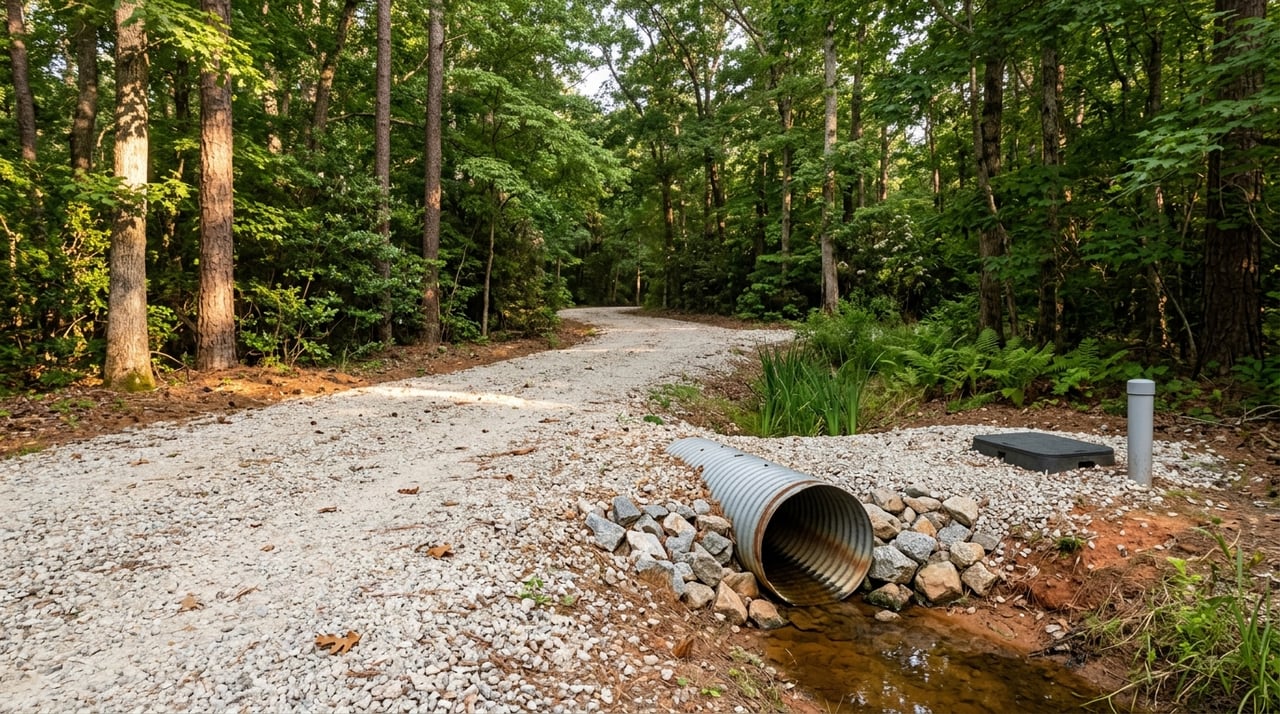
Buying acreage in Laurens County can feel simple at first. You see a beautiful tract, picture the homesite, and start comparing prices per acre. But with land, the real questions usually come down to access, utilities, and site costs. If you understand those pieces early, you can avoid expensive surprises and make a smarter decision. Let’s dive in.
Why access matters first
When you evaluate acreage, legal access should come before convenience. A visible path, old logging road, or dirt drive may look usable, but that does not automatically mean the tract has the legal access you need.
Laurens County’s subdivision ordinance says lots that do not abut a publicly maintained or dedicated road must front on a paved private road or an access easement. The county also requires a minimum access width of 40 feet by recorded deed or recorded non-exclusive easement. That makes recorded paperwork just as important as what you can physically see on the ground.
Public road vs private road
A tract on a public road and a tract on a private road can look similar, but they are not the same. Laurens County defines a private road as one that has not been accepted for public maintenance by the state or county.
If a private road serves the property, the plat and deed must label it as private. The county also states that it is not responsible for operation or maintenance of that road. For you as a buyer, that means road upkeep, repair, and use rights deserve close review before you move forward.
What to confirm about access
Before you buy Laurens County acreage, check these basics:
- Does the tract front on a publicly maintained road?
- If not, is there a recorded access easement?
- Is the access width at least 40 feet where required?
- Is the road or easement shown clearly on the deed and plat?
- If the road is private, who maintains it and how?
These questions matter now, and they matter even more if you may divide the tract later.
Subdivision potential changes the access test
Some buyers want a homesite today and future flexibility later. If that is your plan, access standards become even more important.
Laurens County says newly developed lots must be on, or have direct access to, a road that meets current county road standards or is maintained by a public entity. So if you are comparing tracts with long private access, it is worth thinking beyond today’s driveway and considering whether the property will still work for your long-term goals.
Driveway access may need state approval
If your acreage fronts a state highway, you may need more than just room for a driveway. South Carolina law requires a permit before opening or reconstructing a driveway or side-road entrance on a state-maintained right-of-way.
That permit comes through SCDOT as an encroachment permit. In plain terms, that means you should not assume you can place a driveway anywhere you want. Driveway location and design may be limited by safety and state right-of-way rules.
Utilities are not one-size-fits-all
One of the biggest mistakes buyers make is assuming utility service works the same across all of Laurens County. It does not. Utility availability is highly tract-specific.
Laurens CPW says its electric territory is primarily within Laurens city limits and the Wattsville area. Its water and wastewater service cover the city of Laurens and surrounding areas, while natural gas extends through the greater Laurens area. Service area maps differ by utility, so one tract may have nearby water but not sewer, or electric but not gas.
Laurens Electric Cooperative also serves consumers across Laurens and nearby counties. So you should not assume the same electric provider applies everywhere in the county.
A good first-pass utility check
Laurens County GIS tax parcel mapping includes layers for parcels, roads, gas, electricity, and water. That makes it a useful first step when you want to compare tracts quickly.
Still, GIS is only a starting point. A line shown nearby does not always mean a ready-to-serve connection at your exact property line. It helps you ask better questions, but it should not be your final answer.
When utility connections are straightforward
If utility infrastructure already exists adjacent to the property, Laurens CPW says a new electric, gas, water, or sewer tap can be completed within 15 working days if inspections and payment conditions are met. If utilities are already in place, a new account can be connected within two working days.
That is useful timing information, but it depends on existing infrastructure being adjacent to the property. If lines are not nearby, extension work becomes a separate issue and should be treated as a quote-based item instead of a fixed budget assumption.
No public water or sewer? You need a different plan
Many acreage tracts in Laurens County will not have public water or public sewer. In those cases, the property will generally need a residential well and septic system.
South Carolina’s Department of Environmental Services says that if there is no public sewer, the property will need a septic system. If there is no public water, it will need a residential well. The same agency also warns that some land is not suitable for septic at all.
Septic suitability can make or break a tract
A pretty tract is not always a buildable tract. SCDES evaluates several site factors before approving septic, including soil type, slope, nearby wells, property lines, surface water, the planned house footprint, driveway, and outbuildings.
The department also lists example separation distances that affect layout. These include 5 feet from buildings and property lines, 75 feet from a private well, 100 feet from a public well, 75 feet from surface water, and 25 feet from a drainage ditch. On a smaller or oddly shaped homesite area, those setbacks can reduce your usable building envelope more than you might expect.
Common septic red flags
SCDES notes that these conditions can make septic installation difficult or impossible:
- Rocky ground
- Steep slopes
- Flooding
- Wet soils
- Wetlands
- Fill dirt
This is why two tracts with the same acreage can have very different real-world value. The better-looking property on paper may require more engineering, more cost, or may not work at all for your intended homesite.
Wells have their own rules
If the property needs a residential well, there are rules and timelines to understand there too. SCDES regulates individual residential well permitting in South Carolina.
The agency says wells must be drilled, constructed, and abandoned by a South Carolina certified well driller. It also requires a Notice of Intent before construction. That means well planning should be part of your due diligence, not an afterthought once you own the land.
Asking price is only part of the math
With acreage, the list price is often the easiest number to see and the least complete number to use. What matters more is your total cost to make the tract function the way you want.
A lower-priced tract without legal access, with no nearby utilities, and with difficult soils can end up costing more than a higher-priced tract that is ready for a driveway, power, water, and septic. That is why the best comparison is not just price per acre. It is access plus utility availability plus site work plus permit and timeline risk.
Site work costs to keep in mind
Several common improvement costs can affect your budget:
- Gravel driveway projects often fall in a broad range of $500 to $3,500, with grading, drainage, hauling, and clearing affecting total cost
- Land clearing can average $1,400 to $6,200
- Typical residential well drilling may run about $6,000 to $16,000, depending on depth and related components
- Conventional septic systems may run about $3,500 to $8,500 installed
- Alternative septic systems may run about $4,000 to $15,000
- Engineered septic systems may run about $15,000 to $50,000
These ranges are only part of the picture, but they show why raw land should be evaluated with a full development lens.
Don’t overlook rollback taxes
If the land is currently in agricultural use, improvements can trigger another cost many buyers miss. Laurens County’s assessor notes that changes in use can trigger rollback taxes, including after a new house or mobile home, new subdivision lots, or new parcels below certain sizes.
If you are buying acreage with plans to build or divide it, that is an important question to raise early. A tract’s tax status today may not be the tax status you inherit after making changes.
A practical way to compare two tracts
When you are stuck between two acreage options, use a simple process. Start with legal access, then verify utilities, then compare likely site costs.
A fast first-pass review usually includes the county GIS parcel viewer, deed research, and direct utility confirmation. That combination helps you confirm frontage, recorded access rights, and whether water, sewer, electric, and gas are actually available.
Your acreage due diligence checklist
Use this checklist before you get too far down the road:
- Confirm public road frontage or recorded easement access
- Review the deed and plat for private road language
- Check whether a state-highway driveway permit may be needed
- Use GIS layers to see nearby water, gas, and electric infrastructure
- Confirm the actual utility provider for the tract
- Verify whether public water and sewer are available
- If not, evaluate well and septic requirements
- Look at slope, drainage, wetlands, flooding, and likely homesite area
- Budget for driveway, clearing, trenching, and utility extension work
- Ask whether agricultural use changes could trigger rollback taxes
Why this matters in Laurens County
Acreage in Laurens County can offer space, flexibility, and long-term value. But land rewards buyers who look past the listing photos and ask technical questions early.
When you evaluate access and utilities up front, you put yourself in a much stronger position. You can compare properties more accurately, negotiate with better information, and avoid buying a tract that looks promising but carries hidden cost or risk.
If you are weighing acreage in Laurens County and want a practical read on access, utility questions, and land value, Joseph Cann can help you sort through the details and move forward with more confidence.
FAQs
What counts as legal access for Laurens County acreage?
- Legal access usually means frontage on a publicly maintained or dedicated road, or recorded private access that meets county requirements. A visible dirt path alone may not be enough.
Do Laurens County acreage tracts always have public utilities available?
- No. Utility availability varies by tract, provider territory, and whether infrastructure is adjacent to the property.
What should you check if Laurens County land does not have public sewer?
- You should check septic suitability, including soil, slope, setbacks, flooding concerns, and available drainfield area before closing.
Can you add a driveway to any Laurens County tract on a state highway?
- No. If the tract fronts a state highway, South Carolina requires a permit before opening or reconstructing a driveway or side-road entrance.
Why can a cheaper Laurens County acreage tract cost more in the long run?
- A lower asking price can be offset by expensive access work, utility extensions, clearing, well drilling, septic installation, permit issues, or rollback taxes.