Wondering why two Franklin County tracts with the same acreage can sell for very different prices? In many cases, the answer is standing timber. If you own land, plan to buy acreage, or are trying to price a property accurately, understanding how timber affects value can help you make better decisions. Let’s dive in.
Why timber can raise land value
In Franklin County, fair market value is generally defined by the county tax assessor as the price a knowledgeable buyer would pay a willing seller in an arm’s-length sale. That matters because buyers do not just look at dirt, road frontage, or total acres. They also look at what the timber on the property is worth today and what it may be worth over time.
Standing timber is a separate economic asset from bare land. Two properties with the same number of acres may have very different values if one has merchantable timber and the other has little or none. In practical terms, timber can add meaningful value because it may offer future income, immediate harvest potential, or both.
Georgia also treats timberland differently in some tax situations. State guidance notes that timber is taxed when it is sold or harvested, and qualifying forest land may be eligible for current-use valuation instead of fair market value when it is used primarily for the good-faith production of timber or wood products. Franklin County’s assessor also notes that conservation use or preferential agricultural assessment may be available for good-faith agricultural or forest production.
What buyers and sellers notice first
When someone evaluates land in Franklin County, timber is rarely judged by appearance alone. A healthy-looking stand of trees may or may not have strong market value. What matters most is whether the timber can be sold into higher-value product classes and how costly it will be to harvest.
That is why timber value is usually tied to a few core questions:
- What tree species are present?
- How large are the trees?
- What product class do they fit?
- How much volume is on the tract?
- How easy is it to access and log the property?
These factors often explain why one tract commands a premium while another does not.
Timber traits that affect value
Species mix matters
Georgia’s 2024 forest inventory shows that loblolly pine is the dominant species by volume statewide, and loblolly/shortleaf pine is the most common forest-type group. Oak/hickory is also a major forest type. That matters because pine and hardwood products are often priced differently in the market.
A tract with a strong pine component may be valued differently than one dominated by mixed or lower-grade hardwoods. This does not mean one species is always better than another. It means the market looks at what those trees can become and what buyers are willing to pay for that product mix.
Tree size and product class
Not all timber is priced the same. Georgia Forestry Commission guidance groups trees into product classes based largely on diameter and quality.
In broad terms:
- Pulpwood is generally about 5 to 9 inches DBH
- Chip-n-saw is generally about 9 to 12 inches DBH
- Sawtimber is generally about 12 to 20 inches DBH
- Poles are typically 10 to 24 inches DBH with very straight form
Larger, straighter, better-quality trees usually bring more value because they can be used for higher-value products. So if a tract has mostly small pulpwood, it may be worth less than a similar tract with a strong percentage of sawtimber or pole-quality trees.
Age and stand condition
Age matters, but mostly because it helps tell you what stage the timber stand is in. In Georgia pine stands, the first commercial thinning often happens when trees reach pulpwood size, around 6 inches in diameter, which commonly occurs at about 12 to 15 years old.
As trees get larger, they may move into more valuable product categories such as sawlogs, veneer, or poles. On the other hand, overstocked young stands may need pre-commercial thinning before they become merchantable. In simple terms, an older, well-managed stand may carry more value than a younger stand still in its early growth phase.
Volume and quality
Stumpage value is the value of timber as it stands on the stump before harvesting and transportation costs are deducted. This is one of the most important concepts in timber pricing. A tract with more volume and better quality logs will usually draw more attention than one with limited volume or lower-grade stems.
Size also plays a big role. Larger diameter logs typically contain more board-foot volume, and quality affects how those logs can be marketed. That is why a timber cruise is so important when you are trying to estimate real value.
Access and harvest costs
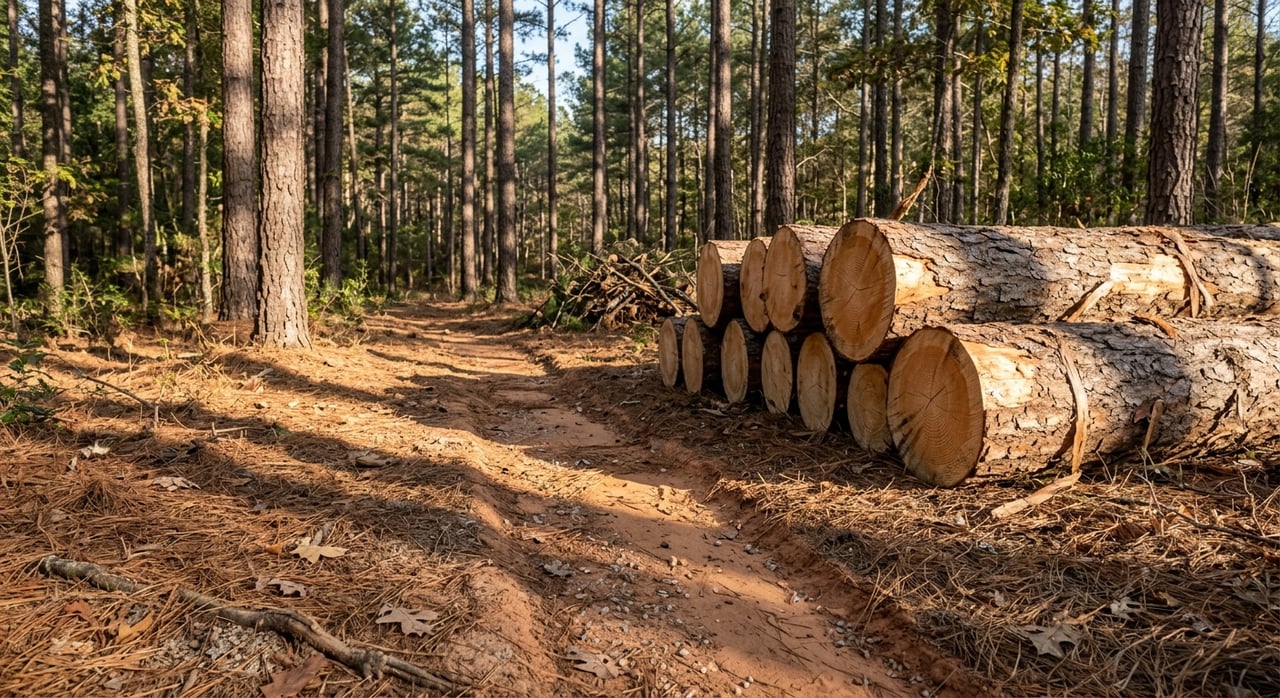
A good timber stand can still lose value if it is hard to harvest. Harvest costs often rise on tracts with poor access, steep slopes, fragile soils, or other logging restrictions. When a buyer expects higher costs to cut and haul timber, bids often come in lower.
On the other hand, tracts that are easier to log can sometimes earn stronger interest. Georgia Forestry Commission guidance notes that land that can be logged in wet weather, or land located closer to a wood-using facility, may receive a premium because the buyer’s costs are lower.
Franklin County market context
Franklin County sits in northeast Georgia on the South Carolina line, so North Georgia stumpage data is the closest public regional benchmark mentioned in the research. Still, these are regional averages, not property-specific appraisals. They are useful as market signals, but they should not be treated as the exact value of your tract.
According to the latest University of Georgia regional data cited in the research, North Georgia averages were roughly:
- $22 per ton for pine sawtimber
- Just over $17 per ton for pine chip-n-saw
- Over $32 per ton for mixed hardwood sawtimber
- Just over $6 per ton for pine pulpwood
- Near $6 per ton for hardwood pulpwood
Those numbers show why product class matters so much. A property with mostly sawtimber-size trees may be viewed very differently from one that is mainly pulpwood. Even if the acreage is the same, the timber value can shift the overall land value in a major way.
Why regional averages are not enough
It is tempting to take a regional stumpage number and multiply it by acres, but that can lead to a very rough and sometimes misleading estimate. Timber value depends on actual species, actual volume, actual product mix, and actual logging conditions on your property. Averages cannot capture those details.
For example, a tract with good interior roads, strong pine sawtimber, and easy truck access may sell well above another tract with difficult terrain and mostly small-diameter timber. From a buyer’s point of view, those are not the same assets. From a seller’s point of view, pricing them the same would miss the real story.
Why a timber cruise matters
If you want to understand how timber adds value to land in Franklin County, a professional timber cruise is usually the smartest next step. Georgia Forestry Commission guidance says a timber cruise helps reduce surprises and is critical to knowing what you are selling. It gives you a clearer picture of species, volume, and product mix.
That information helps answer the questions that matter most:
- How much merchantable timber is on the tract?
- What species are present?
- What product class dominates?
- How easy will it be to log the property?
- How does the current regional market line up with that timber mix?
Without those answers, it is easy to underprice or overprice land.
What this means if you are selling
If you are selling land in Franklin County, timber should be part of your pricing strategy, not an afterthought. Buyers who understand land will look past the acre count and ask what the timber contributes to the deal. If your tract has merchantable timber, that can strengthen how the property is positioned in the market.
It also helps to present the property clearly. A seller who understands species mix, product class, access, and likely harvest conditions is in a better position to explain value with confidence. That can lead to more informed conversations and a more accurate asking price.
What this means if you are buying
If you are buying land, timber can be both an opportunity and a risk if you do not evaluate it carefully. A tract with strong timber value may justify a higher price than bare land, while a tract with limited merchantable timber may not. Looking at the timber separately from the land helps you understand what you are really paying for.
You also want to be careful not to assume that all wooded land has the same value. Some properties have mature, marketable timber. Others may have younger stands, lower-value species, or harvest challenges that affect what the timber is worth today.
Timber value comes down to specifics
The big takeaway is simple: timber can add real value to land in Franklin County, but only when you understand the specifics of the tract. Species, tree size, age, quality, access, harvest cost, and market conditions all shape what a buyer may be willing to pay. That is why two wooded properties that look similar online can trade at very different prices.
If you want a clearer picture of what your land may be worth, it helps to work with someone who understands both real estate and timber. For practical guidance on rural land and property value, connect with Joseph Cann.
FAQs
How does timber affect land value in Franklin County?
- Timber can increase land value when a tract contains merchantable wood that buyers can harvest or manage for future income. Value depends on species, volume, product class, access, and harvest costs.
What timber types are common in Georgia and relevant to Franklin County land?
- Georgia’s forest inventory shows loblolly pine as the dominant species by volume, with loblolly/shortleaf pine as the most common forest-type group. Oak/hickory is also a major forest type.
Why do two Franklin County tracts with the same acreage sell for different prices?
- Two tracts can have very different values if one has more merchantable timber, better product classes, easier access, or lower logging costs than the other.
What is stumpage value for Franklin County timberland?
- Stumpage value is the value of timber as it stands on the stump before harvesting and transportation costs are deducted.
Why is a timber cruise important before pricing Franklin County land?
- A timber cruise helps estimate species, volume, and product mix so you have a clearer idea of what the timber contributes to the property’s overall value.
Are North Georgia timber prices enough to value land in Franklin County?
- No. North Georgia timber prices are useful regional benchmarks, but they are only averages and should not replace a tract-specific timber cruise or property evaluation.